
WattBot Terminal is:
- a."Carfax for contractors."— Director of Sales, national warranty provider
- b."A no-brainer."— Chief Risk Officer, $1B OEM-backed captive financier
- c.Why customers are cancelling LexisNexis.
WattBot Terminal was built for institutions financially exposed to contractor-delivered projects. Trade risk is a complex function of a contractor’s financial health, operational capability and treatment of customers. WattBot Terminal continuously finds and connects material facts across thousands of public and private systems to provide the earliest and most comprehensive view of counterparty exposure. Commercial teams use the same intelligence to find, win and grow business.
Traditional KYB
vs.
WattBot Terminal
WattBot Terminal…
How well do you KYB?
Tracking counterparty exposure requires a networked understanding of a contractor’s history, relationships and performance over time, knowledge of the trades, and signals backtested against historical events.
Terminal graph
A navigable map of the concepts Terminal connects around counterparty exposure.
- FileWattBot Terminal’s company intelligence record brings together an Assessment, the reasoning behind it and the supporting evidence.
- BriefWattBot Terminal’s explanation of what is happening at a company and why it matters, drawing on its operating record, customers, principals and related entities.
- AssessmentWattBot Terminal’s judgment of a company’s standing and trajectory, bringing together everything we know about the business.
- DetectionsThe specific incidents, patterns, institutional actions and commercial strengths that support the Brief.
- Source ReceiptThe supporting record behind a finding, kept so the finding can be traced back to its source.
- BenchmarksThree comparisons for the same company: the industry, similar companies and your own portfolio.
- Legal EntityThe registered business behind an operating name, connected to its records, principals and history.
- Operating Brand / DBAThe name customers know, connected to the registered business and the other names it has used.
- PrincipalOwners and officers traced across the companies they operate and the businesses they were involved with before.
- License HolderThe person a company depends on to meet its contractor-license requirements.
- Shared License HolderSeparate companies, each with its own license, backed by the same individual.
- CustomerFirst-hand experience of what was promised, what was delivered and what happened afterward.
- SuccessorA later business connected to an earlier one through company records and operating history.
- Customer ReportsFirst-hand accounts of sales, project delivery and what happened when customers needed help afterward.
- Company RecordsRegistrations, status changes and historical names that establish which business sits behind an operating identity.
- Company WebsiteHow a company presents its history, people, services and footprint, read alongside independent records and customer experience.
- License RecordsWho supplies the license backing, which company holds the license, where it applies and whether its status has changed.
- Court RecordsThe parties, claims and outcomes in a company’s legal record, with pending cases distinguished from judgments.
- Financial FilingsCreditor claims against a company, its assets and receivables, including secured filings, tax liens and bankruptcy records.
- Regulatory RecordsActions by regulators and licensing bodies that restrict, discipline or investigate a contractor.
- CredentialsTechnical certifications and program designations tied to the company or its people, checked against the issuing institution.
- SparksIndividual customer accounts of harm: an unfinished project, a coercive lien, a misrepresentation or a failure to provide support.
- SmokePatterns across customer experience, operating metrics, company history and research that point to developing problems.
- connects Active Threats
- supports vs Prior 12-Mo
- contains Complaints
- contains Credential Risk
- supports Customer Support
- supports Deception Rate
- contains Detections
- contains Entity Recycling
- contains Entity Standing
- contains Financial Distress
- contains Financing Misrepresentation
- contains Lien Cluster
- contains Litigation Pending
- supports Long-Term Satisfaction
- supports Project Management
- contains Review Manipulation
- supports Sales Conduct
- contains Shared License Holder
- connects Sparks
- contains Stranded
- contains Unlicensed Operation
- supports Value
- supports Workmanship
- FireActions and records from courts, regulators, licensing bodies and other institutions with authority over the company.
- TailwindsEvidence of commercial strength assembled across operating history, customer outcomes, growth, credentials and market standing.
- StrandedCustomers abandoned during or after a project, with unfinished work or unresolved problems and no working route to resolution.
- Predatory LienA lien or threat of one used by the contractor to pressure the homeowner, including coercive or unconsented filings.
- Subcontractor LienAn unpaid trade party places or threatens a lien on the homeowner’s property because the contractor has not paid them.
- Unreleased LienA lien left on the home after cancellation or company failure, with no live party available to release it.
- ComplaintsAccelerating complaints at the BBB or across multiple review platforms.
- Lien ClusterRepeated cases of homeowners facing liens from the same contractor or its unpaid subcontractors.
- Financial DistressCash pressure reflected in accumulating merchant cash advances, rapidly stacking UCC filings, or the company’s own admission of insolvency.
- Entity RecyclingAn operator closes one business and continues through another, with people, operations or customer contracts carried over.
- Entity StandingA company's own legal registration is dissolved, noncompliant or suspended.
- Unlicensed OperationSelling or operating in a jurisdiction where the company holds no valid license.
- Credential RiskLicense backing that exists only on paper, repeatedly changes hands, or could disappear with one person’s departure.
- Litigation PendingLegal action filed or opened against a company that has not yet reached a ruling.
- Financing MisrepresentationReports of a contractor falsely certifying project completion or other facts to obtain funds from a lender.
- BankruptcyChapter 7, Chapter 11, conversion from reorganization to liquidation, or receivership.
- License ActionA licensing board revoking, suspending or otherwise disciplining the company’s license.
- AG EnforcementState Attorney General action against a company: civil suits, investigative demands, settlements and consent agreements.
- Secured ClaimNon-routine creditor claims against company assets, receivables, inventory or project proceeds.
- Tax LienA recorded state or federal tax claim against the company.
- Court JudgmentA civil case that has reached a judgment against the company, including judgments entered by default.
- Program SuspensionRemoval from an incentive program, certification scheme or approved-contractor list.
- Financing SuspensionA financing partner has removed the contractor from its network.
- Safety ViolationAn OSHA or state workplace-safety citation carrying a penalty.
- DurabilityQuality sustained over time, visible in long-term customer experience, continued support and customers who return for more work.
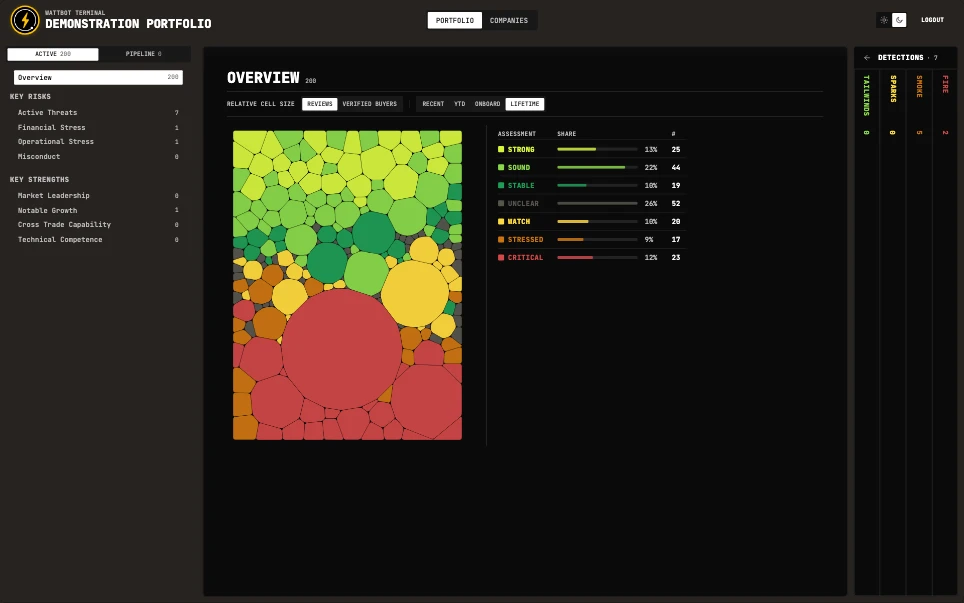
- CRITICALWattBot Terminal assessment: Government, licensing action or insolvency confirmed.
- STRESSEDWattBot Terminal assessment: Multiple serious problems compounding.
- WATCHWattBot Terminal assessment: One area of this company currently under strain.
- UNCLEARWattBot Terminal assessment: Not enough verified data available for assessment.
- STABLEWattBot Terminal assessment: Performing within expected range for its peer group.
- SOUNDWattBot Terminal assessment: Performing better than companies in its peer group.
- STRONGWattBot Terminal assessment: Excellence proven over time in competitive markets.
- ReputationThe public customer record across platforms, examined for the experience behind the ratings and the credibility of the reviews.
- CharacterBehavioral patterns in the customer record, including deception, review manipulation and inconsistency across platforms.
- ExecutionHow the company performs across sales, the work itself, project delivery and ongoing support, drawn from what customers describe.
- Cross-Trade CapabilityRoofing, storage, electrical and HVAC work described by customers, alongside the services the company advertises.
- ActivityThe pace of customer-review activity and how it is changing, with reviews from people who hired the contractor examined separately.
- Local CompetitionHow a company’s Trust Score compares with other tracked contractors serving the same geographic markets.
- HonorsWattBot Terminal’s recognition of measured performance among tracked companies, by market and category: workmanship, customer support or value.
- BackgroundThe business behind the brand: company registrations, historical names, principals, license backing and related entities.
- Entity TimelineCompany names, registrations, people and successor events placed in order so changes in the business can be followed over time.
- Trust ScoreWattBot Terminal’s score combines customer ratings, the experience and credibility behind them, work quality and company conduct.
- Aggregate RatingThe average public star rating across tracked review sources, before the underlying customer experience is examined.
- Rating–Trust GapThe distance between a company’s public star rating and its Trust Score, which accounts for the substance and credibility behind the reviews.
- Platform ListingsA company’s public review presence side by side: platforms, ratings, review counts and source listings.
- Buyer RateShare of reviews from customers who actually hired the contractor rather than quote-shoppers.
- Buyer SatisfactionSatisfaction among reviewers whose accounts show they hired the contractor, separated from sales-only feedback.
- Long-Term Review RateHow much of the review record comes from customers with at least a year of experience with the contractor.
- Long-Term SatisfactionCustomer satisfaction after at least a year with the contractor, beyond initial project delivery.
- Deception RateThe share of reviews describing misleading sales, false quotes or bait-and-switch behavior.
- Review ManipulationUnusually large shares of a company’s reviews arriving in short bursts, a pattern that may reflect coordinated solicitation.
- Platform ConsistencyHow much a company’s ratings disagree across review platforms, accounting for the number of reviews behind each rating.
- Sales ConductHow people describe the sales process: honesty, pressure, respect for cancellation and whether commitments were kept.
- WorkmanshipThe quality of the physical work as customers experienced it: installation, finish, cleanup and care for the property.
- ValueWhether customers feel the work and its outcome justified the cost.
- Customer SupportWhat happens when a customer needs help after the work is done: responsiveness, warranty follow-through and resolution.
- Project ManagementHow projects are coordinated and delivered: scheduling, permits, inspections and keeping the customer informed.
- RoofingHow much roofing work appears in the customer record, and how satisfied those customers were.
- StorageBattery-storage experience reflected in customer accounts: how often the work appears and how satisfied those customers were.
- ElectricalElectrical work beyond the solar installation itself, identified in customer accounts and assessed for customer satisfaction.
- HVACHeating and cooling work in the customer record, assessed for its prevalence and customer satisfaction.
- Services MarketedThe services a company advertises, kept distinct from the work customers describe it performing.
- 12-Mo Review AvgAverage reviews per month over the last year, providing a view of the pace of customer activity.
- vs Prior 12-MoThe change in review activity over the last year compared with the year before.
- Buyer Activity TrendThe change in review activity from people who hired the contractor, comparing the last year with the year before.
- Market RankA company’s Trust Score position among tracked contractors in each geographic market.
- Active ThreatsCompanies facing institutional action or active problems in licensing, legal standing and continuity of the business.
- Financial StressCompanies under pressure from tax debt, creditor claims, unpaid suppliers or judgments, before or outside bankruptcy.
- MisconductCompanies showing misrepresentation, coercive selling, financing abuse or harm to homeowners’ property titles.
- Operational StressCompanies falling behind peers on workmanship, service or project delivery, alongside cases where customers have been left stranded.
- Notable GrowthCompanies with a substantial rise in review activity from customers who hired them, outpacing similar companies.
- Technical CompetenceCompanies with substantive technical credentials or program designations, including evidence of field experience, installation quality or specialist capability.
- Market LeadershipCompanies ranked in the top 10% of larger markets or the top five in smaller ones, alongside recognition for execution quality.
Terminal graph ready
(click to explore)
Frequently Asked Questions
- Our focus is residential solar and home improvement. WattBot Terminal is most suitable for institutions exposed to contractor-delivered projects: big-ticket purchases where sales practices, workmanship quality, trade expertise, customer relationships and financial health determine your risk.
- WattBot Terminal draws from thousands of public and private sources, including federal, state, territorial and local records; licensing boards and corporate registries; courts and bankruptcy dockets; UCC, tax and creditor systems; enforcement and safety records; and review platforms. Every finding is auditable, so your team can make decisions with confidence, address concerns with the contractor, and explain its decisions to credit committees and capital partners.
- WattBot Terminal’s secret sauce is the combination of three systems, plus judgment gained from decades of solar and home improvement contractor management. System One collects material facts across thousands of public and private sources. System Two disambiguates the actual business entity across DBAs, lookalike names, corporate transactions, ownership changes, principals and license holders. System Three connects those facts across entities and over time to identify patterns, which we backtest against historical events. Human judgment is overlaid to understand the significance of specific threat patterns. For example, a supplier’s UCC filing may reflect ordinary financing. But alongside unpaid subcontractors, bond suspensions and a departing license holder, it can point to serious financial distress.
- Our job is to maximize your chances of reducing loss rates. That means helping your team recognize deterioration and establish enough conviction to act before exposure accumulates. For example, our customer dissatisfaction signal predated bankruptcy and trade license revocations by a median of 1.5 years. Even a few weeks can matter while you are still extending credit, releasing funds or committing resources.
- Commercial teams use WattBot Terminal to find quality contractors, decide who deserves white-glove treatment, and work through approval concerns faster. They can identify accounts ready for more business, make a case for better terms, and help contractors resolve problems. Continuous monitoring also helps risk and commercial decide what needs resolving before approval and what can be managed as the relationship develops.
- WattBot Terminal is priced competitively with traditional KYB services. You get a much more comprehensive understanding of the businesses you’re trusting with your money, customers and reputation. While traditional KYB is priced by sources, checks, reports or database access, WattBot Terminal is priced per contractor (your unit of counterparty exposure). We support portfolios of all sizes, with one-time assessments and continuous monitoring. Before you decide, put us to the test.
Put us to the test
Free portfolio audit. No commitment.
- 1.30-min call to assess fit.
- 2.Share up to 20 contractor names.
- 3.See the results and ask:•Did you see something you did not know?•Would it have changed a past decision?•Do you get this with your current KYB?